
Call nowBook onlineInsurance enquiry
Portland Physiotherapy - FitzroviaPortland Physiotherapy - FitzroviaPortland Physiotherapy - FitzroviaPortland Physiotherapy - Fitzrovia
  • About us
  • Services
    • Physiotherapy
    • Massage Therapy
    • Acupuncture
    • Ultrasound-guided injections
    • Workstation Assessment
    • Muscle Balance Assessment
    • Gait Analysis (Video Running Analysis)
    • Shockwave Therapy
  • FAQ
  • Testimonials
  • Blog
  • Partners
  • Contact Us
  • About us
  • Services
    • Physiotherapy
    • Massage Therapy
    • Acupuncture
    • Ultrasound-guided injections
    • Workstation Assessment
    • Muscle Balance Assessment
    • Gait Analysis (Video Running Analysis)
    • Shockwave Therapy
  • FAQ
  • Testimonials
  • Blog
  • Partners
  • Contact Us
News
27th September 2016

What is Shin Splints?

Shin splints is an umbrella term for a number of different injuries that can occur in the shin/lower leg area. Although these can present quite differently, the causative factors are often the same and may include: abnormal biomechanics such as excessive supination or pronation (rolling in and out) of the foot, tight or weak lower leg muscles, leg length discrepancy, ankle instability and overuse (increased running and sports) or training errors.

Below are 2 common types of shin pain which can occur separately or together:

Medial tibial traction periostitis (MTTP)

MTTP presents as a diffuse pain along the inside of the shin bone (tibia) which can decrease with warming up, although worsen the following morning. Repetitive loading combined with abnormal biomechanics can place extra stress on the tibia where the leg muscles attach leading to inflammation. This is a common injury in runners and females who are three times more likely to develop it. MTTP tends to be the most common type of shin pain we see as Physiotherapists.
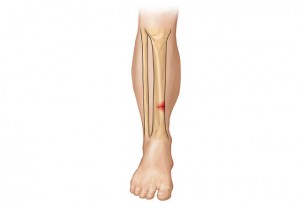
Stress Fracture

Stress fracture of the tibia or fibula

If left too long MTTP can lead to the development of a stress fracture in one of the lower leg bones (tibia or fibula).  A stress fracture is a small hairline break in the bone generally due to repetitive loading and impact. This presents as an isolated pain on the front of the shin that worsens with exercise and weight-bearing and may be painful at rest or at night.These often require 4-8 weeks rest off activity and occasionally unloading of the shin through the use of a moonboot or crutches.

If you have shin pain it is important to see a Physiotherapist to diagnose exactly what injury you have and to address the causative factors. Rest from impact activities and ice may initially help, however there are generally biomechanical errors that need to be modified to prevent the problem reoccurring or worsening.

A Video Gait Analysis may help identify the causes of your shin pain. You can read more about Gait analysis here.

OC Physio
0
News
26th September 2016

What is cadence and how do I increase it when running?

Read this post on Oxford Circus Physiotherapy:

What is cadence and how do I increase it when running?
OC Physio
0
News
26th September 2016

Skiing Injury Prevention and Fitness

Read this post on Oxford Circus Physiotherapy:

Skiing Injury Prevention and Fitness
OC Physio
0
News
25th September 2016

Iliotibial band friction syndrome

Read this post on Oxford Circus Physiotherapy:

Iliotibial Band Friction Syndrome
OC Physio
0
Archives
  • May 2021
  • April 2021
  • February 2021
  • January 2021
  • April 2020
  • December 2018
  • May 2018
  • December 2017
  • July 2017
  • September 2016
Categories
  • News
About us

Portland Physiotherapy is an established Physiotherapy Practice in London’s West End. We treat sports and spinal Injuries, Post operative rehabilitation, back and neck pain, Overuse and running injuries.

Private Medical Insurance

Covered by all major Private Medical Insurance companies; Allianz, Aviva, AXA, Bupa, Cigna, Simply Health, WPA. If your insurance company is not listed above, don’t worry, this is not an exhaustive list. Please contact us and we will confirm over the phone.

Contact us
  • 57 Great Titchfield Street, W1W 7PN
  • +44 (0)20 3475 5767
  • info@portlandphysio.co.uk
  • WhatsApp
© Portland Physiotherapy 2024. All Rights Reserved.
Privacy Policy